
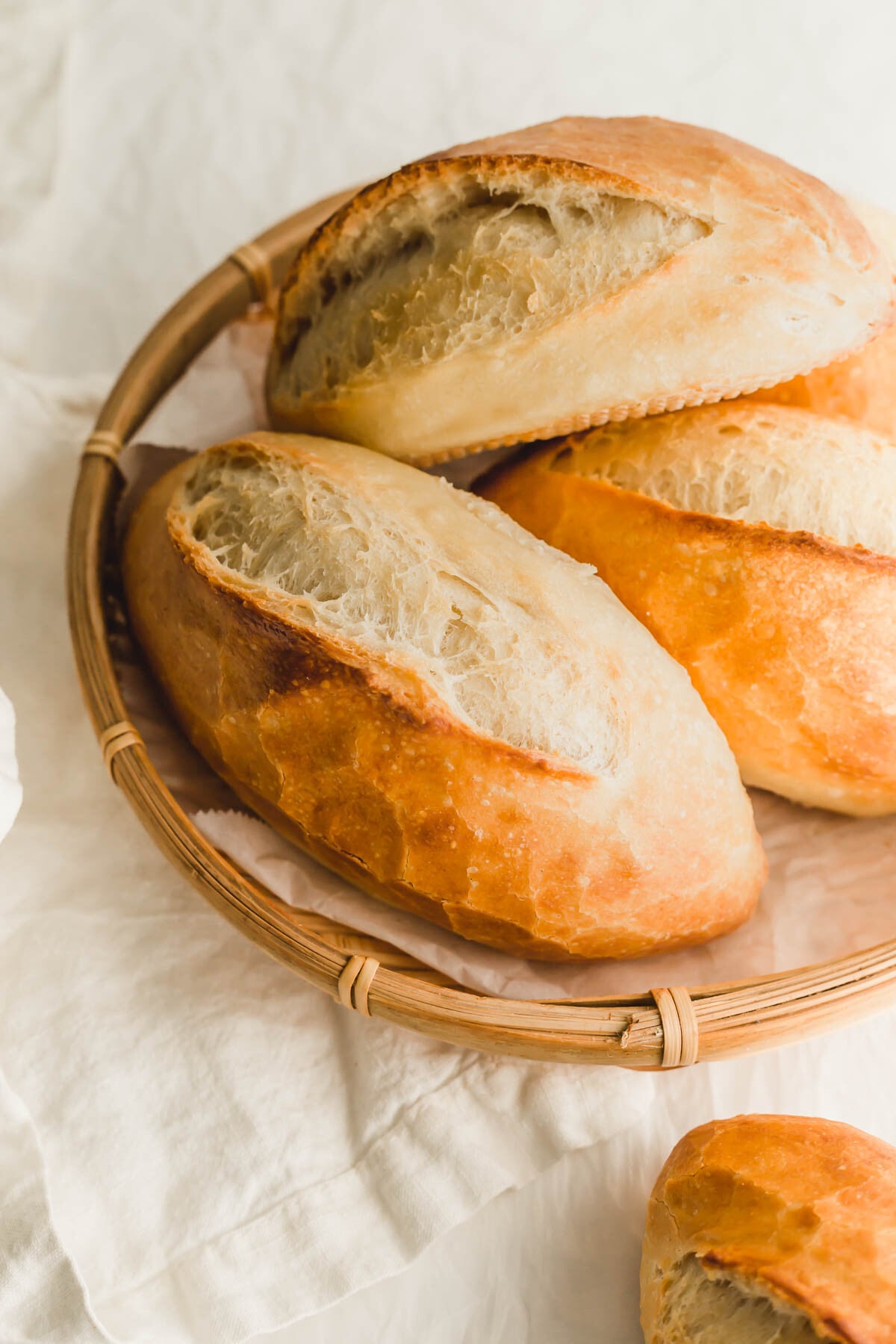
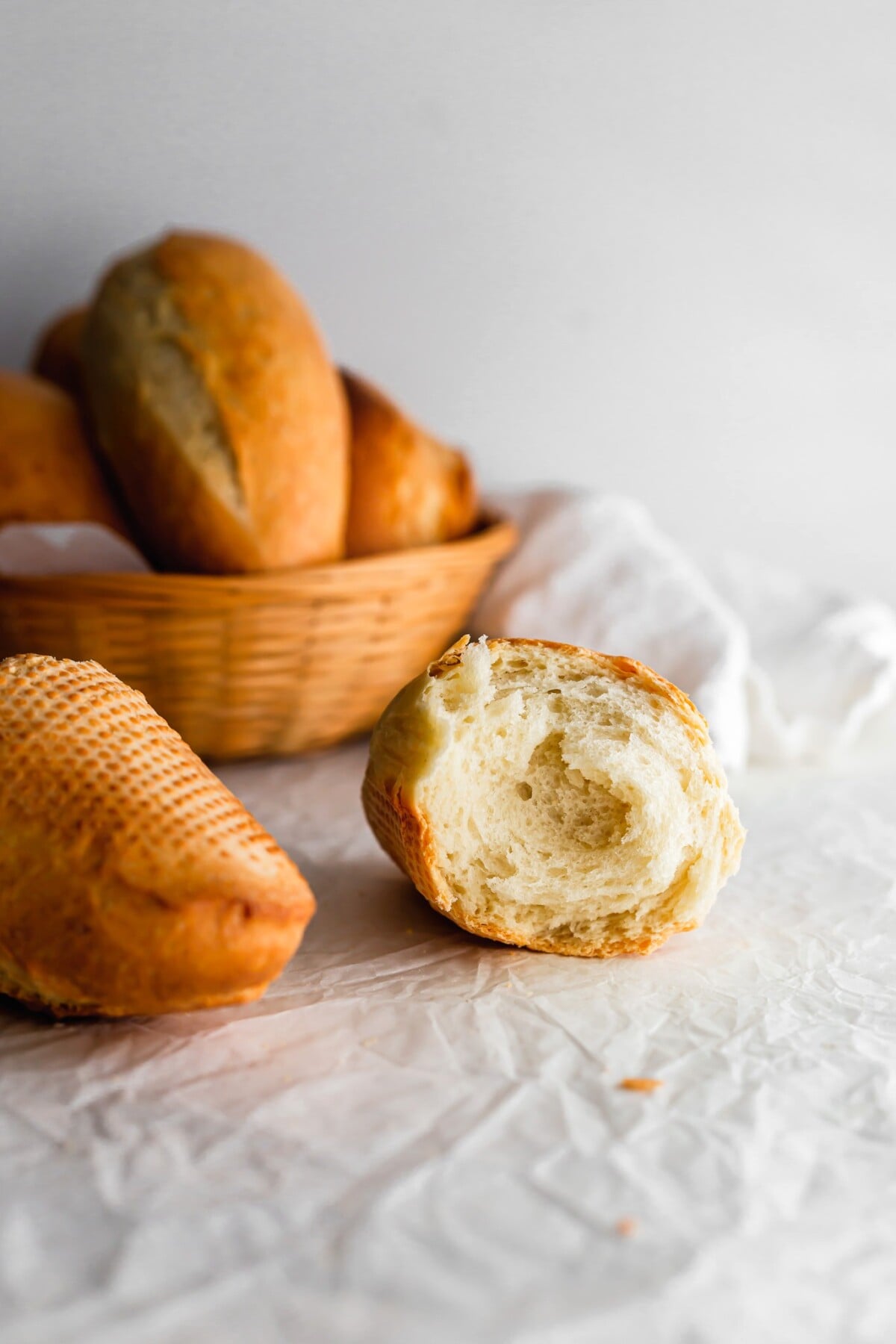
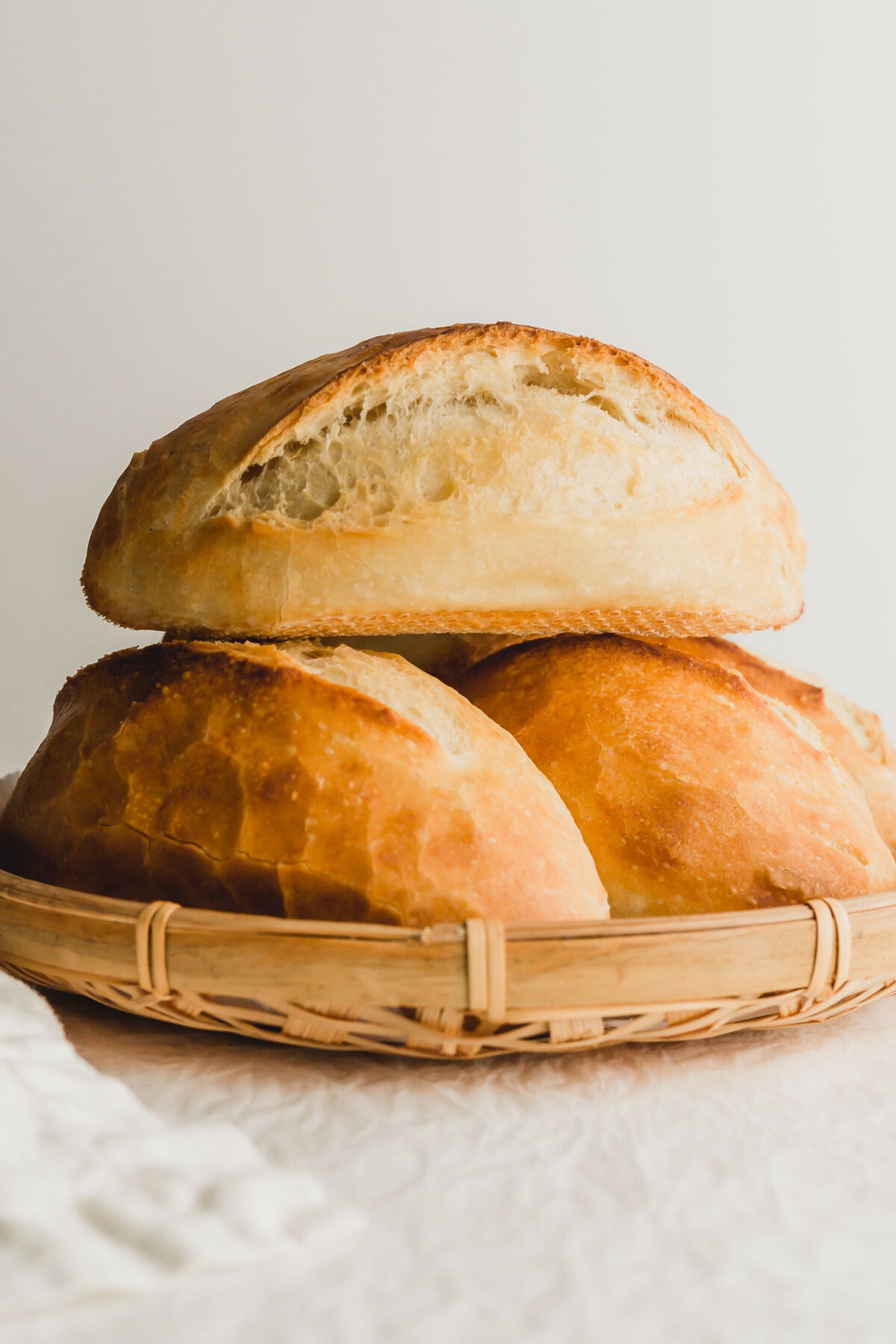
This Vietnamese Bánh Mì Baguette is soft and fluffy inside with a crisp, crackly crust. It's the perfect base for Vietnamese bánh mì sandwiches. Made with a few simple ingredients, this recipe brings Vietnamese-style baguettes right into your home kitchen.
This recipe first appeared on Sift & Simmer in Dec 2020. Updated October 2025.

Want to save this recipe?
Enter your email & I'll send it to your inbox. Plus, get great new recipes from me every week!
What is banh mi?
In Vietnamese, "bánh mì" simply means "bread."
However, it's also the name of the beloved Vietnamese sandwich made with a light, airy baguette that's crisp on the exterior and soft within.
The sandwich is often filled with pickled vegetables, cold cuts (such as cha lua), pâté, and fresh herbs.
History of bánh mì
Bánh mì has its roots in French colonial Vietnam. French baguettes were introduced in the 1800s and were originally enjoyed with butter, sugar, or pâté.
By the 1950s, Saigon street vendors had reimagined the French baguette, creating the modern bánh mì Sài Gòn -- lighter, airier, and perfectly suited to local flavors.
Today, it's an iconic Vietnamese street food enjoyed worldwide.
What's the difference between bánh mì vs. French baguette?
While they may look similar, bánh mì baguettes differ from French baguettes in texture and structure:
Bánh mì baguettes are lighter, airier, and crispier.
French baguettes tend to be denser and chewier with a thicker crust.
Why you'll love this recipe
It's light, airy, and crisp just like Vietnamese bakery baguettes.
Made with simple ingredients, no bread improver or Vitamin C (ascorbic acid) and clear, foolproof steps.
Perfect for pairing with your favorite bánh mì sandwiches or stews.
Ingredients you'll need
- bread flour: has a higher protein content which produces gluten strands, which is needed for a soft and elastic dough. If you don't have bread flour, you can use all-purpose flour, but be sure to knead the dough for the recommended time to reach windowpane stage.
- active dry yeast: activate the yeast in lukewarm water, unless using instant yeast
- water: lukewarm water helps to activate the yeast
- sea salt: enhances flavor
- whole egg: adds richness and yields a tender crumb
- granulated sugar: feeds the yeast and helps crust brown
- vegetable oil: helps with browning and adds moisture
Notes
On rice flour:
Some recipes call for rice flour to create a lighter texture, but in my testing, it made the baguettes dense and tough. I recommend sticking with wheat flour for the best result.
On adding egg:
Traditionally, bánh mì dough is made with just flour, yeast, water, and salt.
On testing, I found that adding one egg gives the interior crumb a softer, more delicate texture, similar to a light brioche.
Special equipment
- baguette pan: perforated to hold shape and promote even baking; I recommend metal and not silicone
- dough scraper: for easy portioning and shaping; metal or silicone
- clean water spray bottle: to create steam in the oven for crusty exterior
- sharp serrated knife or bread lame: for scoring clean slashes before baking
How to make Vietnamese-style bánh mì bread
Make the dough
In a measuring cup, combine warm water, sugar, and yeast. Give it a stir and let it sit until foamy.
Add all ingredients to a stand mixer fitted with a dough hook.
Knead on medium speed for 10-12 minutes, until smooth and elastic. The dough should stretch thinly without tearing (windowpane stage* see expert tips below).
Transfer to a lightly oiled bowl, cover, and let rise until doubled in size (about 1 hour in a warm spot).

Shape the dough
Once risen, divide the dough into 6 equal triangular portions (Step 1 above).
Slap the dough to release any air bubbles and shape into a triangle.
Start from the "pointy" end of the triangle and roll and pinch the sides, while working your way down (Step 2).
Seal the ends and place onto a perforated baguette pan (Step 3).
Repeat with the remainder.
Cover lightly with a damp cloth and leave to rise in a warm location, until puffy and almost doubled in size, about 30-45 minutes.
Preparing the oven
Towards the end of the proofing time, preheat oven to 425F.
Place a roasting pan filled with hot water on the bottom rack to create steam.
Baking the baguettes
Spray the baguettes with water.
Make a swift yet controlled slash at a 45 degree angle on each baguette with a sharp knife or baking lame (Step 4).
Spray the tops of the baguettes with water again.
Place the baguettes into the oven and quickly spray the baguettes with water (to create steam) before shutting the oven door.
Bake for a total of 22 minutes. Every 2 minutes, open the oven door and spray the baguettes with water, until 6 minutes have elapsed (do this 3 times, every 2 minutes).
When there is 10 minutes left in the baking time, carefully remove the roasting pan with hot water and let the baguettes continue to bake.
Cool the baguettes completely on a wire rack before slicing.
Watch how to make bánh mì baguettes
How to serve
Enjoy freshly baked bánh mì baguettes as the base for a classic Cold Cut Bánh Mì, with Vietnamese Beef Stew (Bò Kho), or simply with butter and condensed milk for a nostalgic treat.
Slice up the baguettes and use it in a Banh Mi Charcuterie Board. Pair with iced Vietnamese coffee,
The Vietnamese-style bread is best enjoyed on the same day it's baked.
How to store and reheat
Room temperature: store in a paper bag for up to 1 day.
Fridge: keep in an airtight bag for up to 1 week.
Freezer: freeze in an airtight freezer bag for up to 1 month.
To reheat: warm in a 350°F (175°C) oven for 10-12 minutes to restore crispness.
Expert tips
Don't skip the steam! A combination of misting and a tray of hot water in the oven is key to achieving that crisp, crackly crust.
No baguette pan? Shape the dough onto a rice flour covered-towel, and create a "couche" /well for each baguette for proofing. You'll need to be careful when you transfer the shaped baguettes to the baking sheet for baking.
Windowpane stage: to test if your dough is ready, take a small piece and gently stretch it between your fingers. If it forms a thin, translucent "window" without tearing, your gluten is well-developed and the dough is ready for bulk fermentation.
Slashing the tops of the loaves helps to prevent the bread from exploding or being mis-shapened.
Every oven bakes differently: adjust the rack position or baking time slightly if needed.
Don't skip the rest periods: they help the dough relax for smooth shaping and even baking.
Other delicious Vietnamese recipes you may like


Did you make this recipe?
Let me know if you try out this recipe -- I love seeing your creations! Tag me on Instagram @siftandsimmer and be sure to leave me a comment/rating below!
Vietnamese Bánh Mì Baguette
Equipment
- baguette pan
- spray bottle
- dough scraper
- sharp knife/bread lame
For accuracy and precision in baking recipes, use weight (metric) measurements when available.
Ingredients
- 270 ml warm water
- 2 g granulated sugar
- 7 g active dry yeast
- 500 g bread flour or all-purpose flour
- 5 g sea salt
- 30 ml vegetable oil
- 1 large egg
Instructions
Make the dough:
- Measure out the warm water into a large measuring cup.
- Stir in the sugar and yeast. Give it a mix to activate the yeast.
- Add the flour, salt, oil, and egg into a stand mixer bowl fitted with a dough hook.
- Once the yeast is bubbly, pour it into the flour mixture.
- Knead the dough until it is smooth and elastic, at least 10 minutes on a stand mixer at medium speed (depending on your mixer's horsepower).
- The dough is ready when you can stretch a little bit of the dough between your fingers and it creates a thin "windowpane."
- Transfer the dough to a lightly oiled bowl and cover.
- Let it rest in a warm location, until doubled in size.
Shape the dough:
- Once risen, divide the dough into 6 equal triangular portions.
- Slap the dough to release any air bubbles and shape into a triangle.
- Start from the "pointy" end of the triangle and roll and pinch the sides, while working your way down.
- Seal the ends and place onto a perforated baguette pan. (I placed 2 pieces of dough on each "well").
- Repeat with the remainder.
- Cover lightly with a damp cloth and leave to rise in a warm location, until puffy and almost doubled in size.
Preparing the oven:
- Towards the end of the proofing time, preheat oven to 425°F/218°C.
- Adjust the oven rack to the 3rd from the bottom.
- Carefully add a large roasting pan filled with hot boiling water to the bottom rack of the oven.
Baking the baguettes:
- Spray the baguettes with water using a clean kitchen spray bottle.
- Make a swift yet controlled slash at a 45° angle on each baguette with a sharp knife or baking lame.
- Spray the tops of the baguettes with water again.
- Place the baguettes into the oven and quickly spray the baguettes with water (to create steam) before shutting the oven door.
- Bake for a total of 22 minutes. Every 2 minutes, open the oven door and spray the baguettes with water, until 6 minutes have elapsed (do this 3 times, every 2 minutes).
- When there is 10 minutes left in the baking time, carefully remove the roasting pan with hot water and let the baguettes continue to bake.
- Cool the baguettes completely on a wire rack before slicing.
Notes
Nutrition
The nutritional information provided should be considered as approximate and is not guaranteed. Please use your best judgment to ensure food is safely prepared and/or a good fit for your diet.
Recipe adapted from Aimee's Cooking.



Ellen
Excellent recipe that I will love to do this over and over again! Your video helps tremendously! There is always room for improvement rolling out and shaping the dough! Yours look absolutely fantastic using the baguette pan. But I can’t ask for more when my bread all came out crispy and soft! Thank you for sharing this recipe! 🥖
Michelle
Glad the recipe worked out for you, Ellen! A baguette ban will definitely help hold the shape more easily. Thanks for sharing your creation with me on Instagram! 🙂
Jessica Formicola
You just can't beat homemade bread, and these banh mi baguettes are no exception! They turned out perfectly!
Michelle
Glad you enjoyed the recipe Jessica! Thanks for stopping by!
Natalie
Yum, perfect texture and crust. Looks delicious! Have to make this asap. Thanks for this recipe!
Toni
This has been one of our favorites for sandwiches! Thanks for the recipe!
Michelle
They sure are versatile for sandwiches, thanks for your comment, Toni!
Kris
So soft and delicious! Can't wait to make again! 🙂
Michelle
Glad you enjoyed the recipe, Kris!
Kirstine Chrautwald Sort
Great recipe! ❤️
Michelle
Thanks for trying the recipe and sharing your creation with me on Instagram, Kirstine 🙂
Steve
The apparent conversion button (US Customary) is not functioning and I have to do a lot of converting to get to cups and tablespoons. Any way you could post it in a format that doesn't require a kitchen scale?
Steve
Recipe is trial and error as the water content is not enough to create "thin windowpane" stretch. I guess it doesn't need to be, but maybe it does? Increase liquid and keep working on it to get it right. Not a 5/3 ratio of normal bread, but the 4/1 ratio is a bit light. Maybe 1.75 cups of water instead of 1.25 cups?
Tayler Ross
We've made these several times and they turn out perfect every time! Thanks for sharing!
Linsey
I love eating banh mi! They are so crisp on the outside and cottony soft on the inside. Way better than French baguettes. So yummy to enjoy the sandwich with some pork and pickled daikon and carrot.
Lynn
Hi Michelle, thank you for providing the recipe! I can only find European baguettes here so I thought I’d have a go at making them myself.
I tried the recipe yesterday and unfortunately they came out really dense and not very crispy, with a thick crust. I tried to follow the recipe as closely as possible but here are a few changes I had to make: I only have a hand mixer with kneading attachment, I did knead it for 10 minutes but a proper stand mixer would have probably done a better job; couldn’t find bread flour because the entire flour aisle was empty so used all purpose I still had in the pantry; and I put my baguette pan on a rack not a roasting pan in the oven. I noticed the dough seemed much sticker than yours but it rose really nicely. Which one do you think was the culprit? I’ve never made bread before so I’m sure I messed up somewhere 🙈
Also another question, should the recipe still work if I halve the ingredients to make 3 baguettes? Should I then leave out the egg or use one egg anyway?
Thank you so much!
Michelle
Hi Lynn -- thanks for your comment.
For this recipe, using a high-powered stand mixer will produce better results as the time required to knead the dough is quite long. It is in kneading the dough for that extended period of time which produces the light and cottony texture. For your next attempt, you may want to gauge whether the dough has formed a thin "windowpane" membrane rather than basing it on the 10 minutes, as it can take much longer if using a hand mixer or kneading by hand.
As long as you're kneading the dough for enough time, it will work with either all-purpose or bread flour.
Did you spray the dough with water at the stated intervals while it was baking? The steam creates the crispy exterior crust.
Also, the roasting pan should be filled with hot water and it should sit on the bottom rack of the oven, not directly on the baguette pan.
You could divide the recipe in half, but you'll also have to use half an egg, which is about 27g, if you have a digital scale. Hope that helps.
John Chludzenski
Can't wait to give this a shot. Love making Bahn Mi using thin slice Char Sui Pork, pickled veggies and dipping it in homemade Pho broth. Sorta like an Asian french dip.
Michelle
Sounds like an amazing combination, John!
Ange
This recipe is a keeper! Made it twice and each time, we get thin, shattering crust with creamy crumb. They freeze well too. They are great as a base for pizza too!
Ben
In "Equipment" you should put "stand mixer" 😉
JB
I thought these were fantastic. I’ve never tried any other banh mi bread recipe but this is exactly what I look for in a banh mi; soft and fluffy but crispy on the outside, where the sandwich will squish nicely and not get soggy from any wet ingredients. My crust didn’t look nearly as crispy and blistered as your pictures but I think that was a steam issue. Anyway, this would also be a great bread for meatball subs, French dip, etc! Really anything that you want to hold together while also being a bit wet.
Michelle
Hi JB, thank you very much for your feedback. Glad that you enjoyed the recipe! And you're right, this bread would be fantastic for other applications too. 🙂
helen
great recipe!! made this a couple times now and turns out better each time :))
Michelle
Hi Helen, thanks so much for your comment, and for sharing your tasty creation with me on Instagram!
Healthy World Cuisine
Loving how crispy your banh mi baguette is and all of your helpful hints for that perfect texture. Perfect picnic weather food!
Jules
Thanks for a great recipe! I was thrilled these turned out even though I used APF!
Michelle
Thanks for leaving your feedback and sharing your lovely creation with me on Instagram, Jules!
Wendy
I love this! I've tried other banh mi baguette recipes and this is the best! Really enjoyed the fluffy bread! However, it's not as crispy as the ones I've had in Vietnam! How can i make it even crispier? Help! 😀
Michelle
Hi Wendy, thanks for your feedback. It may depend on your oven -- to make it crispier, you may need to start your initial bake at an even higher temperature and continue intermittently spraying the baguettes for a longer period of time. Hope that helps.
Kim
Hiii! Quick question — are you spraying for a total of 3 times? Or are you saying to spray the baguettes every 2 minutes for a total of 18 minutes? Instructions are a little confusing!
Michelle
Hi Kim, spray the baguettes a TOTAL of 3 times (once every 2 minutes for the FIRST 6 minutes of the bake).