
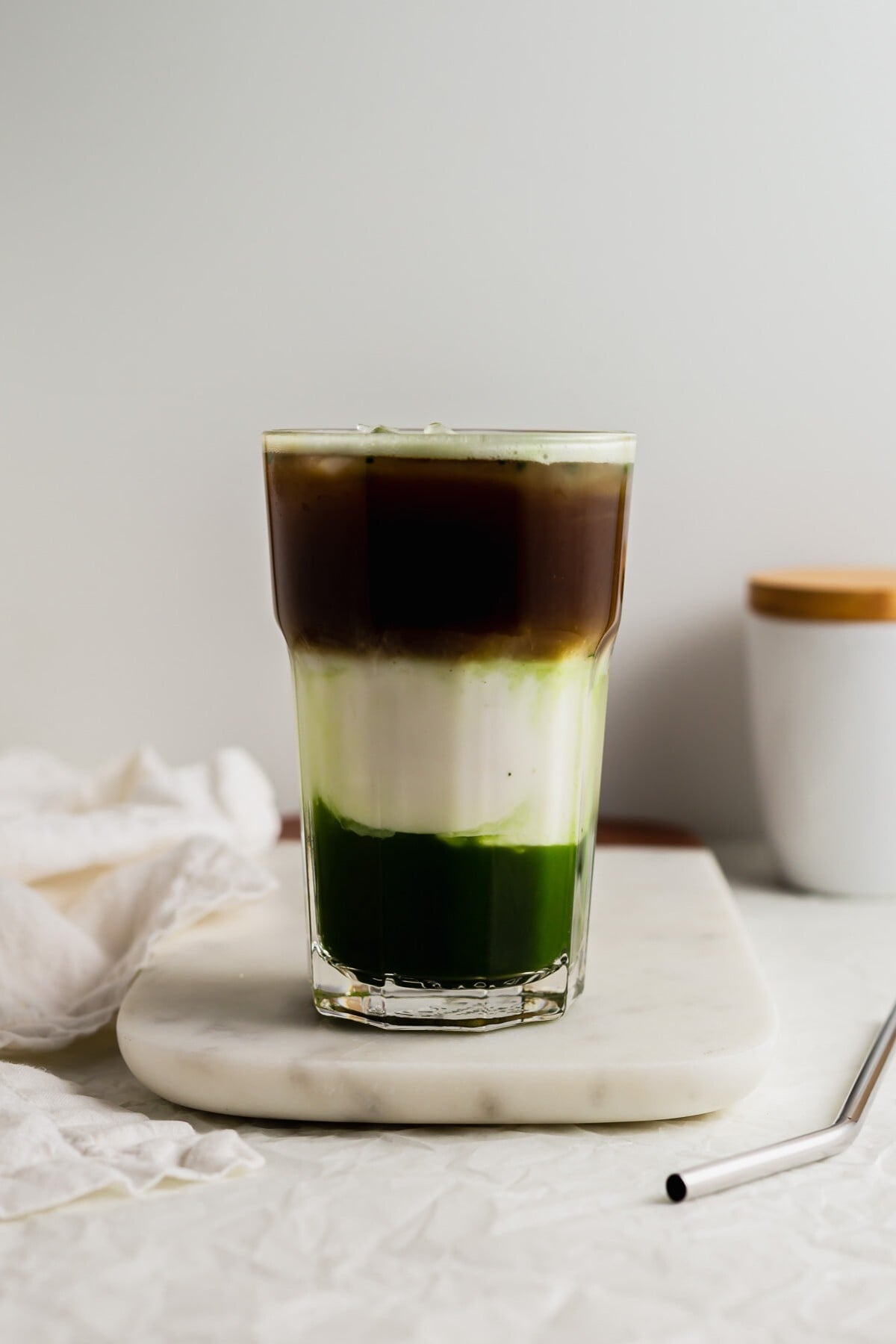
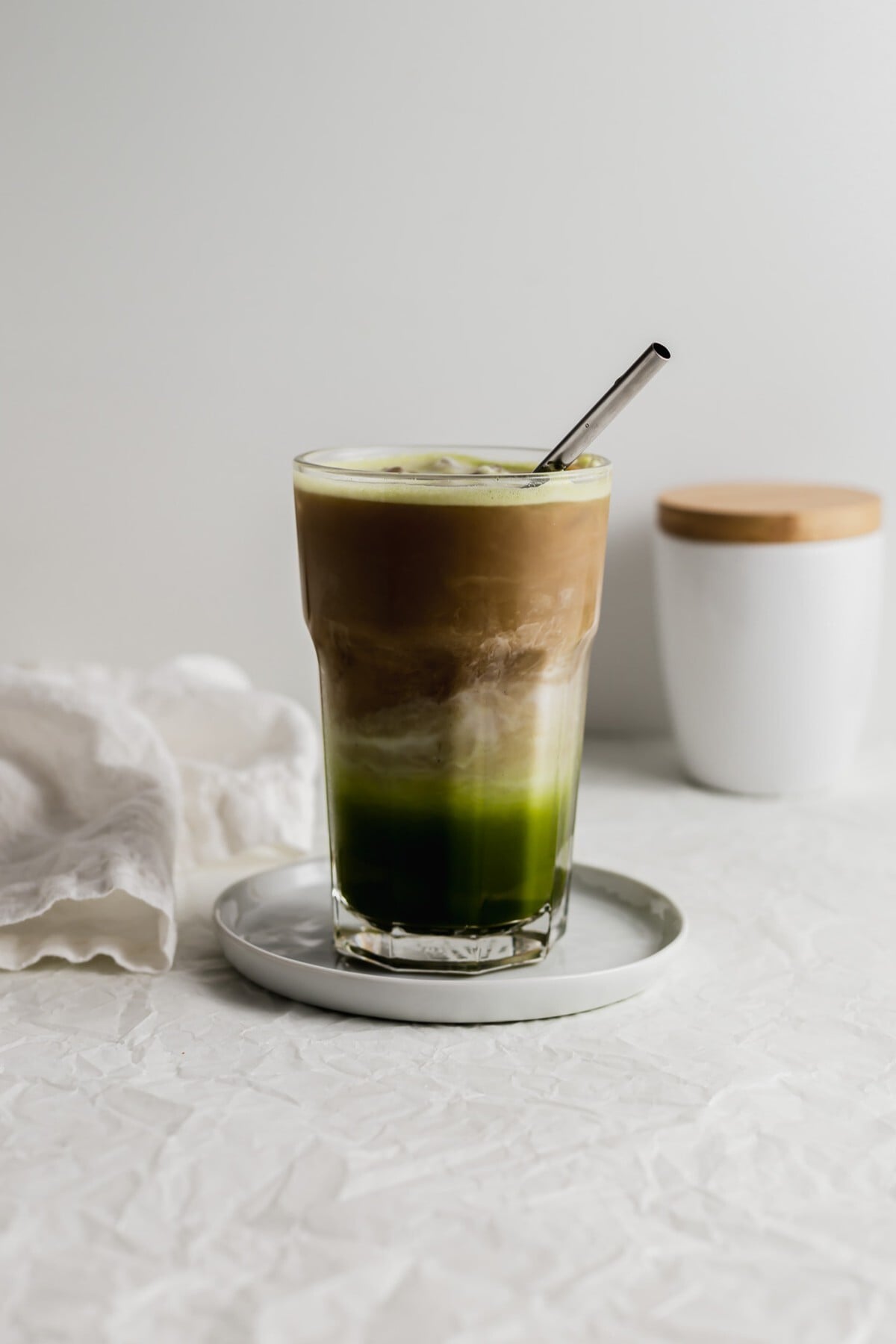
This Iced Matcha Espresso Latte is a beautiful 3-layered drink consisting of lightly sweetened matcha green tea and hot espresso poured over milk.
Want to save this recipe?
Enter your email & I'll send it to your inbox. Plus, get great new recipes from me every week!
This drink goes by various names -- dirty matcha latte, camo latte, military latte, coffee matcha latte, or matcha espresso fusion [as termed by Starbucks in Asia], but it's essentially an iced matcha with espresso coffee.
It consists of matcha on the bottom, milk in the middle, and hot espresso floating on top.
Why you'll love this recipe
If you've searched for a matcha latte recipe with espresso or wondered how to make an iced matcha latte with espresso without it turning muddy brown, this is the technique that keeps the layers clean.
This Matcha Espresso Latte is a visually stunning layered drink consisting of three main components:
- matcha green tea
- milk
- espresso coffee
It reminds me of Hong Kong-style Yuen-Yueng, which is a popular drink made of 3-parts coffee to 7-parts milk tea.
What is matcha?
Matcha is finely ground Japanese green tea powder.
It is green in color and it does contain caffeine.
If you're new to matcha, check out my Beginner's Guide to Matcha.
Matcha espresso vs. Hong Kong milk tea coffee
Hong Kong milk tea (or yuenyeung) is coffee stirred into milk tea, while a matcha espresso latte is coffee floated on top of a matcha-milk drink for a visual effect before you stir it together yourself.
If you like the tea-and-coffee combo but want something creamier and less caffeinated per sip, Yuenyeung is the better starting point; if you want the visual "wow" and a more pronounced matcha flavor, stick with this recipe.
Variations of matcha and coffee
Dirty matcha latte: is another name for this same drink; "dirty" refers to the espresso shot added to a milk-based drink.
Matcha Americano: matcha with hot water and no milk at all, sometimes with an espresso shot added; covered in more detail in the FAQ below.
Matcha coffee (blended): matcha and coffee stirred together from the start, rather than layered.
Ingredients you'll need
- matcha: I recommend using a high-quality matcha, sifted to remove any clumps for the best flavor
- room temperature water: for dissolving the matcha powder
- cold milk: for the middle layer; you can use any type of milk or non-dairy alternative
- hot espresso coffee: should be freshly pulled hot espresso shots, or hot strong coffee; you can also use decaf or regular
- granulated sugar: or any sweetener will do, such as simple syrup
- crushed ice
The temperature of the ingredients does matter. Keep on reading to find out why.
How to create a layered drink
First, a quick lesson in physics.
If you didn't pay attention in high school physics (guilty!), then it's time to pay attention now.
Density = Mass / Volume
In order to obtain the different layers in the drink, we need to create different densities in each liquid.
Keep in mind that temperature also affects density.
It is for the reason that the bottom matcha layer has sugar added to it.
How to make a layered matcha espresso latte
For our bottom layer, we'll need to make this the heaviest so it will sink to the bottom.
To do this, we'll add sugar to the matcha and room temperature water to create a dense liquid.
Then, add ice to the glass.
The next layer is the milk layer, which will sit on top of the matcha.
Now comes the tricky coffee espresso layer.
In order to get the espresso layer to float, remember that temperature affects density?
Hot water will float on top of ice because it is less dense than cold water.
Why? The hot water molecules are excited and spread farther apart and take up more space in an area. Now that we know this, rest assured that the hot espresso will naturally float to the top.
Physics lesson over.
Watch how I make the matcha espresso latte
My tips on creating clean distinct layers
First, I have an important trick to share with you when it comes to creating clean layers:
1) Use a spoon.
If you tried to pour the milk over top the matcha, the gravity of the liquid would pull it down, potentially muddling the layers.
When you pour the liquid over the back of the spoon, it gently trickles down slowly, leaving the layers intact.
2) Also, for the layers to be distinct and separate, ensure that there's enough ice to cover the diameter of the serving glass.
3) Ensure the espresso is freshly pulled and hot before pouring it over the ice.
3) Add a touch of sugar to the middle milk layer to ensure the coffee layer floats on top.
Common mistakes & troubleshooting
Even with the physics explained, a few small missteps can muddy your layers. Here's what usually goes wrong and how to fix it:
The espresso sinks instead of floating. This almost always means the espresso wasn't hot enough, or too much time passed between brewing and pouring. Use espresso straight off the machine. It should be at or near boiling when you pour it. If you're using stovetop or strong drip coffee instead of espresso, make sure it's freshly brewed and hot, not lukewarm.
The layers mix as soon as you pour. This is a pouring-technique problem, not a temperature one. Pour too fast, or pour directly into the liquid instead of over the back of a spoon, and gravity pulls everything together instantly. Slow down, hold the spoon just above the surface, and let the liquid trickle down the back of it.
The matcha layer looks clumpy instead of smooth. This happens when matcha is added straight to water without sifting, or when it's whisked into water that's too hot or too cold. Sift your matcha first to break up clumps, and dissolve it into room-temperature (or lukewarm) water with a small whisk or matcha whisk (chasen) rather than a spoon, which doesn't break up clumps as effectively.
There isn't enough ice, so the layers slump. Ice acts as a physical barrier between the matcha and milk layers while they settle by density. If the glass is only half-filled with ice, the layers have more room to swirl into each other on the way down. Fill the glass with crushed ice most of the way before adding any liquid.
The drink tastes bitter or overly grassy. This is usually a matcha-quality or matcha-to-water ratio issue rather than a technique issue - see the FAQ below on matcha grade and water temperature.
The milk layer disappears or looks too thin. If your milk and matcha layers have similar densities (for example, using a very light non-dairy milk with no added sugar in the matcha), the middle layer can be thin or hard to see. Adding a touch of sugar to the matcha layer (as in the recipe) increases its density relative to the milk, which keeps the middle layer more visually distinct.
Milk variations & dairy-free options
The recipe works with almost any milk. Here's how different options affect the look and taste of the middle layer:
Whole milk or 2%: the classic choice. High enough fat content to create a rich middle layer that holds its own against the matcha and espresso.
Oat milk: the most popular dairy-free swap for this drink. It's naturally a little sweeter and creamier than other plant milks, which helps it hold together as a distinct middle layer and pairs well with matcha's grassy notes.
Almond milk: lighter and thinner than oat milk, so the middle layer may be less visually distinct. Adding a touch of sugar to the milk (as noted in the recipe) helps.
Soy milk: has a body closer to dairy milk and works well for layering; a good option if you want a dairy-free drink with a creamier mouthfeel than almond milk.
Coconut milk (the carton kind, not canned): adds a mild coconut flavor that pairs nicely with matcha, though it's on the lighter side for layering.
Lactose-free dairy milk: behaves identically to regular milk for this recipe, since only the lactose is removed, not the fat or protein.
A general rule for dietary swaps: the creamier and slightly sweeter the milk, the more easily it holds a distinct middle layer.
Very thin, watery plant milks (some rice and nut milks, for example) can blur into the matcha layer below. If that happens, adding a small pinch of sugar stirred into the milk before pouring will fix it.
Coffee-forward variation & ratios
If you want this to taste more like a coffee matcha latte -- more coffee-forward with matcha as an accent rather than the base, adjust the ratios like this:
Increase the espresso to 3 oz (roughly a double shot) instead of 2 oz.
Reduce the matcha to 1 teaspoon instead of 2, still dissolved in the same ¼ cup of room-temperature water.
Keep the milk and ice the same.
This shifts the flavor balance so the roasted, bittersweet espresso notes lead, with the matcha adding a grassy background note rather than being the dominant flavor.
Stir well before drinking either way, since the drink is designed to be layered for looks first, then mixed together.
Ice types (for the best iced version)
Ice does double duty in this recipe -- it chills the drink and it's the physical barrier that keeps your layers from collapsing into each other while they settle. A few things matter more than you'd expect:
Use crushed ice, not large cubes: Crushed ice packs together and fills the width of the glass, so liquid poured on top spreads evenly across the surface instead of running down the gaps between big cubes. Large cubes leave channels that let the milk and espresso slip straight down to the bottom.
Fill the glass generously with ice: at least two-thirds full, before adding any liquid. Too little ice means less of a barrier and more room for the layers to swirl together.
Standard ice cube trays work: if that's all you have -- just crush the cubes first (a zip-top bag and a rolling pin or the flat side of a knife works fine) rather than dropping them in whole.
Avoid nugget or "Sonic-style" ice if you can: it's soft and tends to melt fast, which dilutes and destabilizes the layers before you get to drink it.
FAQs
Does matcha contain caffeine?
Yes, matcha does contain caffeine so this is drink is not suitable for children.
Can you make Matcha Espresso ahead of time, or does it need to be fresh? The layered version needs to be made fresh -- the whole effect depends on temperature differences between the matcha, milk, and espresso, and those differences disappear within a few minutes as everything comes to the same temperature.
That said, you can prep components ahead: dissolve the matcha and sugar and keep it covered in the fridge for up to a day, and keep milk chilled and ready.
Just brew the espresso fresh and hot right before assembling and pouring, since a cooled-down espresso won't float on the layers.
What's the ideal water temperature for dissolving matcha powder without damaging its nutrients?
Water between about 160-175°F (70-80°C) is the sweet spot... hot enough to dissolve the matcha smoothly, but below the roughly 185°F (85°C) point where heat starts to break down some of matcha's delicate compounds and can turn the flavor bitter or metallic.
For this recipe specifically, we call for room-temperature water rather than hot water, since the matcha layer needs to stay cool and dense to sink to the bottom -- you're not trying to fully "brew" the matcha the way you would for a hot cup, just dissolve it evenly.
How to store leftover matcha powder, and how long does it stay fresh at home?
Keep matcha in an airtight, opaque container away from light, heat, and moisture -- a kitchen cupboard works well, and some people keep it in the fridge for extra protection (just let it come back to room temperature before opening to avoid condensation).
Unopened, matcha typically keeps its quality for about a year. Once opened, it's best used within 1-3 months; after that it won't spoil in a way that's unsafe, but the color dulls and the flavor flattens.
Can you make a hot version of Matcha Espresso that still keeps distinct layers?
Distinct layers rely on ice as a physical barrier, so a fully hot version won't hold clean layers the way the iced one does -- the liquids will blend together as you pour.
If you want a warm version, it's best to make it as a hot dirty matcha latte instead: whisk hot matcha and a little sugar with steamed or warmed milk, then pour hot espresso over the top. It won't stay layered for long, but it will still give you that espresso-floating-then-swirling-in moment as you stir, and it tastes just as good.
Other matcha recipes you may like
Did you make this recipe?
Let me know if you try out this recipe -- I love seeing your creations! Tag me on Instagram @siftandsimmer and be sure to leave me a comment/rating below!
Iced Matcha Espresso Latte (Dirty Matcha Latte)
For accuracy and precision in baking recipes, use weight (metric) measurements when available.
Ingredients
- 1-2 teaspoon granulated sugar or to taste
- 2 teaspoon high-quality matcha sifted
- ¼ C water room temperature
- 6 ice cubes crushed, or enough to fill ⅔rd of your serving glass
- ½ C whole milk or non-dairy alternative
- 2 oz freshly brewed hot espresso or hot strong coffee
Instructions
- Place sugar and matcha in the bottom of a tall glass. Add water and mix well to dissolve the matcha and sugar.
- Add crushed ice cubes to the glass.
- Take a spoon and turn it around so the back side is facing the top. Position the spoon slightly above the ice. Carefully pour milk over top the back of the spoon. The milk will gently drizzle over top of the ice.
- Next, using the same technique, carefully pour the hot espresso over the back of the spoon on top of the milk and ice. The espresso will float to the top.
- Stick a straw in, give it a stir and enjoy.
Notes
Nutrition
The nutritional information provided should be considered as approximate and is not guaranteed. Please use your best judgment to ensure food is safely prepared and/or a good fit for your diet.

Biana
This looks so good! I like different twists on coffee, will be trying this soon.
Michelle
Thanks Biana! 🙂
Sarah Hovey
Want more delicious ideas for iced or hot caffeinated drinks
Beth
This looks amazing and so delicious! My daughter is going to love trying this! Can’t wait to show this to her!
Michelle
Awesome, hope she enjoys it, Beth 🙂
Jessie
Thank you for the share on this one! I love it when I can make the drinks at home and can skip the drive thru in the morning
Michelle
Isn't that so true? Thanks Jessie!
Tracy
Wow now this is a drink! Love a great fusion. This is so so good - thank you!
Michelle
Glad you enjoyed it, Tracy! 🙂
rika
I love how easy it is to make! It's a refreshing drink that I can enjoy every day without breaking my wallet!
Michelle
Amazing, thanks Rika! 🙂
Hitesh
Btw a lame question.... Do you mix all the layers before drinking
Michelle
No worries, yes mix the layers before drinking. Enjoy! 🙂
David @ Spiced
Ah, what a fun combination of flavors! I can see why this drink is so popular. I actually have everything needed to make this, and I'm thinking of whipping it mid-morning today. After the daylight savings time shift, I need an extra shot of espresso today...and this is a unique way to get it! 🙂
Michelle
Yes indeed! The perfect counterbalance to DST! Haha! Thanks David 🙂
Abbe@This is How I Cook
I was awful in science, but I can follow a recipe and this sounds fabulous. I have had a container of matcha that I need to do something with. This is it!
Michelle
Oh thanks for stopping by Abbe! Hope you enjoy it! 🙂
Heidi | The Frugal Girls
I think I am in love with this double caffeinated deliciousness you've created!
Michelle
Thank you Heidi!! It's so yummy!
Katherine | Love In My Oven
This is sooo pretty Michelle. So perfect on a hot day! I'm glad you did all the scientific testing for us and now I can just follow your recipe 🙂
Michelle
Thanks Katherine! The double-caffeination is needed this week! 😛
Holly
Beautiful drink! I love the color gradation and it is just so pretty. I like the science behind the layered drink. Density= Mass / Volume. I will remember that principle.
Michelle
Thanks Holly! Glad you enjoyed the science part! 😉
Ben | Havocinthekitchen
This is undoubtedly absolutely stunning! I've never made any layered drinks, and I also hated most excact sciences at school - so thank you for a detailed explanation of the idea. If most physics examples were like this recipe, it would be so much fun to learn it haha.
Michelle
Thanks Ben! True, I think I would've paid more attention in class if it involved more food-based experiments! 😀 😀 😀
Dawn - Girl Heart Food
How fun and how gorgeous! I just love the colours and layers and totally wishing I could grab that drink right from my screen!
Michelle
Thank you Dawn! Wish I could send you a drink!
2pots2cook
Wow ! my cup of tea ! Beautiful photos !!!! As usual 🙂
Michelle
Thank you Davorka! 🙂 Have a fantastic day!
Natalie
what a beautiful drink and absolutely delicious!!! thank you for sharing this recipe with all the important details like pouring the layers on the back of a spoon and the science behind the layers 🙂 super fun drink to make, will definitely make again ! 💯
Michelle
Thank you for sharing your creation with me on Instagram, Natalie! Glad you enjoyed the recipe 🙂
Eric22
It looks delicious, especially with all those layers!
HWC Magazine
This matcha espresso was just the kick we needed this weekend to get things done around the house. The flavor is smooth and earthy. We did not add any sweetener because that is how we roll. If you are new to matcha, it would probably be best to add a little sweetener as the flavors are bold.